Oh dear, oh dear…I find myself waking up and thinking about everything there is to do and panicking just like the white rabbit…I’m late I’m late.
Well, the only excuse is it has been a cold month. Well, in truth not even that, it has been a rough old switchback of a month, one mild sunny day and the next back to snow showers.
We have snow forecast on the tops again tonight. So I have let other things dominate my time and energy; but the balance must shift back now and 'just get another layer of fleece on and get out there woman!'
I have been around the garden looking for signs of spring and my goodness they are all there. The other evening I had a walk around and several “oh my goodness look at that” experiences.
Here are a few of them:
White Daphne mezeron, this just gets better slowly every year and of course a scent to knock your head off.
The snowdrops and snowflakes are giving way to the daffodils, and this year more than any other I have loved taking the daffodils indoors to watch the buds open. They are wonderfully cheerful.
Some nice crocus tomassinianus here and there, but for every ten we plant, the mice and voles find and eat nine. Still onwards and upwards, and let’s hope they have a population collapse this year..…the mice not the crocus.
The Rhododendron praecox has defied all the odds and has avoided the frost on its ridiculously early blossom. It is a wonderful cloud of violet purple. Bravo.
Hellebores are everywhere. Where we remember, or when they look too spotty, we cut the old leaves off and that lets the flowers show off really well and the new leaves seem to accelerate through. All sorts of flowers; doubles, dark and pale singles, white and spotty ones and some robust excellent hybrids like ericsmithii. Such great garden value.
Margaret Davidson
Showing posts with label Nurseries. Show all posts
Abriachan Hydro scheme - March Update
Despite a cold, occasionally wintry month…there has been really good progress with the new Abriachan hydro scheme. (Click here to read the first explanatory blog post)
The cement arrived for casting the base for the turbine and was pumped over the stream ( the Kilianan) by a 120ft long elephant’s trunk.
The turbine building has been making steady progress and walls all in now.
The pipe to carry the water was welded together in sections and dragged down the hill to lie in its ditch like a giant black anaconda.
And most exciting, the new 99kw turbine arrived on a very sophisticated lorry and was craned into the new building and connected. The old turbine made its way out on the same day and was trucked away. A small wistful glance from us all watching it go, when it operated well it was a good friend.
So, so far, good progress but quite a bit to go yet.
The cement arrived for casting the base for the turbine and was pumped over the stream ( the Kilianan) by a 120ft long elephant’s trunk.
The turbine building has been making steady progress and walls all in now.
The pipe to carry the water was welded together in sections and dragged down the hill to lie in its ditch like a giant black anaconda.
And most exciting, the new 99kw turbine arrived on a very sophisticated lorry and was craned into the new building and connected. The old turbine made its way out on the same day and was trucked away. A small wistful glance from us all watching it go, when it operated well it was a good friend.
So, so far, good progress but quite a bit to go yet.
A New Abriachan Hydro Scheme
When we came to Abriachan in 1983 there was a small hydro
electric scheme operating.
The stream it ran off is the Kilianan and has a
fantastic 100ft plus head of water. The scheme was put in in the late 1940’s, by the then owners the Woodwards and was installed by an engineer relative of theirs, Mr Mackenzie. He ran an ice factory in Inverness and was obviously very able and put the scheme together.
The piping was sources from pipes that were laid around Inverness in the 2nd world war to provide emergency water supplies, when needed. Real post war imagination and innovation.
It gave about 20KW and was a Gilkes of Cumbria turbine. That
was more than enough for our house and the nursery for about 9 months of the
year
We kept the system going for quite a number of years, but
the age of the systems and the increasing costs of repairs made it increasingly
uneconomical, and we closed the system down in about 2005.
And then along came support for renewable energy and feed in
tariffs and the whole economics of small hydro schemes changed. And now, DHG (Dulas) hydro is installing a new hydro scheme in the Kilianan. The design and
capacity is now more advanced and it will be producing up to 100kw and feeding
electricity into the grid. It should be
up and operational by the end of 2015.
All very exciting. We
will put up photographs as things progress.
Lots of folks are asking what’s going on….so here is the keep up to date
space.2015 Plant Catalogue Now Online
The New 2015 Plant Catalogue for Abriachan Nurseries is now online and landing on doorsteps around the country.
We hope you enjoy this years selection, the plants we list in our catalogue have proven their worth as good garden plants, or are part of one of our collections such as Auricula & HelianthemumWe also like our plants to have a little “je ne sais quoi” whether that be lovely scent, a flash of subtle colour, or just looking right in the place or association where they grow.
Click here to download the pdf of the catalogue
This year has the addition of a new Falkland Island Page where we have increased our selection of plants from this remote, unique and beautiful part of the world.
And my garden ideas for this year, I am going to re-read the books of Christopher Lloyd. As his years matured he introduced more colour into his garden. And that is where I am in 2015, the year of colour. I love annuals and will be planting all I can, additionally Dahlias and Lilies and who knows what else.
Watch our Flickr site and my blogs for ideas and progress.
I am also working up some “planting recipes“, a selection of gardening ideas for you to consider trying, along with instructions and prices. They will be on our web site.
Good gardening
Margaret Davidson
A snowy Spring
We actually had a couple of hardy souls visiting the garden
today…but the snow showers beat them
Of course it is magic and tomorrow we are promised winter
sunshine. We have the first of the snow drops and Aconites out for sale, even
though they have a thin crust of snow on their pots.
Activity levels are pretty high. Hamish has been cutting
down and chipping trees, in preparation for the start of the new hydroelectric
scheme that will be installed by Dulas. All rather exciting and I will tell
that story soon. Donald has been tidying
and burning (always favourite) and moving dead and fallen shrubs.
Considering the post-Christmas gales we got off lightly……a lilac and a shallow rooted oak tree, and lots of branches.
So we came back from New Zealand and have adjusted
remarkably fast to cold and snow. Just so long as it does not go on too long!
A walk through the garden shows the spears of snowdrops pushing through everywhere. The witch hazels are wonderful and the evergreens are looking splendid as they always do in mid-winter.
And me, I am finishing the catalogue…..Cat has done a
great cover and we are almost go for 2015
Margaret DavidsonROCK ROSES - The Helianthemums
The Sun loving Rock Roses
The rock roses have always been favourites of our and a look at our catalogue will show a whole range of varieties to choose from.
We love them because they thrive in our sandy, sunny beds and look just wonderful when the sun comes out through June and July. The yellow form is one of our native plants and that would explain a lot.
They grow fast and have a great mat-forming habit that excludes weeds. What more can you ask? Well to top it all they really put on a great show.
A couple of years ago we; well Donald really; decided we needed a new wall in the car park area and once neatly finished, we discussed what to grow there. Of course we could plant a new rockery, but knowing all too well how difficult it can be to keep up with weeding we came around to a Helianthemum wall. It is a great success as you see.
My favourites are the vivid orange colours such as Henfield Brilliant and the rich yellows, like Sterntaler, but there are days when the clear pink of Rhodanthe Carneum,. Or the modest double pink flowers of Annabel attract the eye.
There was a range of Helianthemum named for some of Scotland’s highest mountains, the Bens. Hence we have Ben Macdhui and Ben Mhor and Ben Ledi etc. You can collect them after you climb them
Two other Scots specials are Broughty Beacon and Broughty Sunrise, both named for an area of Dundee and they really do have the bright flickering colours of the ends of the day as they would be seen along the Firth of Tay.
Maybe the manufacturers of Iron Brew should sponsor a new variety as that particular orange would look very well as a rock rose colour.
The Year of The Poppy
Back in winter I clearly recall saying to Donald ”This is 2014 and if ever there was one, this is the year of the poppy”
And so it is. We have the 100 year anniversary of the outbreak of the 1st world war, and as August approaches we will all be swept up in the reflection and memories that the date and its attendant ceremonies will awaken.
Anyone of my post 2nd world war generation will be steeped in family stories and memories of the 1914-1918 war. They were 50 year old memories when I was a teenager, and my grandfather was gone, at a younger age than necessary as the long shadow of the trenches and gassing and the whole experience took its long slow toll on many British men.
The memories and reflections have freshened in recent years, and the annual Memorial Day ceremonies are now very well attended, and red poppies are a potent symbol in our lives.
Looking around the nursery and the garden, it has been surprising and pleasing to see the range of poppies we grow and Donald has responded to my never ending desire to add more.
I’ll keep the reporting coming over the summer and autumn as they come into flower, but here is the first instalment and they look terrific.
Californian Poppy (Escholtzia californica)
These are fabulous and without peer on a warm sunny day. We grow the single orange, no mixtures or frilled varieties as I find they just do not have the impact and sheer exuberance of the orange. They now self-seed for us, and that gets things moving after a mild winter.
Iceland Poppies (Papaver nudicaule)
A favourite as we used to grow lots in The Falkland Islands, where they seemed to thrive on cool summers and sea spray. Well they would wouldn’t they.
Best grown as seed & growth year 1 (sown in March/April or even May) and up to flower year 2. A good percentage carries on into years 3 and 4.
They make really good cut flowers, plunge them into a deep jug of water.
Welsh Poppies (Meconopsis cambrica)
Tough, easy to grow poppies. We like to create areas of the garden where they are all yellow or all orange, and I love the red ones that pop up unexpectedly in many corners. Very tolerant of woodland shade and hence extremely useful to brighten dull corners.
Oriental Poppies (Papaver orientale)
These are the huge early summer poppies. They have large heads and centres of quivering black stamens. All colours are wonderful, but the reds and pinks stand out for us with performance and you have to love the huge whites with black thumb prints at the base of the petals and the striking black centres. Feed well and have a nearby perennial or some annuals to take over the space as these die down. Show stoppers!
Himalayan Poppies (Meconopsis)
Any gardener will have heart stopping moments of pleasure when they see these superb blue poppies growing well. We have acid sandy soil, and provided we keep them well fed, and watch they do not dry out, these aristocratic, elegant plants do wonderfully well for us.
There are a range of cultivars and some very nice coloured variants like Hensol Violet.
I’ll try and guide you through them and all our other poppies, including the fabulous ladybird poppies, in another Blog another time.
MD
And so it is. We have the 100 year anniversary of the outbreak of the 1st world war, and as August approaches we will all be swept up in the reflection and memories that the date and its attendant ceremonies will awaken.
Anyone of my post 2nd world war generation will be steeped in family stories and memories of the 1914-1918 war. They were 50 year old memories when I was a teenager, and my grandfather was gone, at a younger age than necessary as the long shadow of the trenches and gassing and the whole experience took its long slow toll on many British men.
The memories and reflections have freshened in recent years, and the annual Memorial Day ceremonies are now very well attended, and red poppies are a potent symbol in our lives.
Looking around the nursery and the garden, it has been surprising and pleasing to see the range of poppies we grow and Donald has responded to my never ending desire to add more.
I’ll keep the reporting coming over the summer and autumn as they come into flower, but here is the first instalment and they look terrific.
Californian Poppy (Escholtzia californica)
These are fabulous and without peer on a warm sunny day. We grow the single orange, no mixtures or frilled varieties as I find they just do not have the impact and sheer exuberance of the orange. They now self-seed for us, and that gets things moving after a mild winter.
Iceland Poppies (Papaver nudicaule)
A favourite as we used to grow lots in The Falkland Islands, where they seemed to thrive on cool summers and sea spray. Well they would wouldn’t they.
Best grown as seed & growth year 1 (sown in March/April or even May) and up to flower year 2. A good percentage carries on into years 3 and 4.
They make really good cut flowers, plunge them into a deep jug of water.
Welsh Poppies (Meconopsis cambrica)
Tough, easy to grow poppies. We like to create areas of the garden where they are all yellow or all orange, and I love the red ones that pop up unexpectedly in many corners. Very tolerant of woodland shade and hence extremely useful to brighten dull corners.
Oriental Poppies (Papaver orientale)
These are the huge early summer poppies. They have large heads and centres of quivering black stamens. All colours are wonderful, but the reds and pinks stand out for us with performance and you have to love the huge whites with black thumb prints at the base of the petals and the striking black centres. Feed well and have a nearby perennial or some annuals to take over the space as these die down. Show stoppers!
Himalayan Poppies (Meconopsis)
Any gardener will have heart stopping moments of pleasure when they see these superb blue poppies growing well. We have acid sandy soil, and provided we keep them well fed, and watch they do not dry out, these aristocratic, elegant plants do wonderfully well for us.
There are a range of cultivars and some very nice coloured variants like Hensol Violet.
I’ll try and guide you through them and all our other poppies, including the fabulous ladybird poppies, in another Blog another time.
MD
2014 Catalogue - Now Online
So our daughter Cat and her partner Brad are on The Falkland
Islands…that is bringing back so many memories. Memories of the Camp, the
wildlife and the vivid gardens full of sun loving annuals.
The Falkland Islands were sunny, cool and windy too of
course but I remember many, many sunny days.
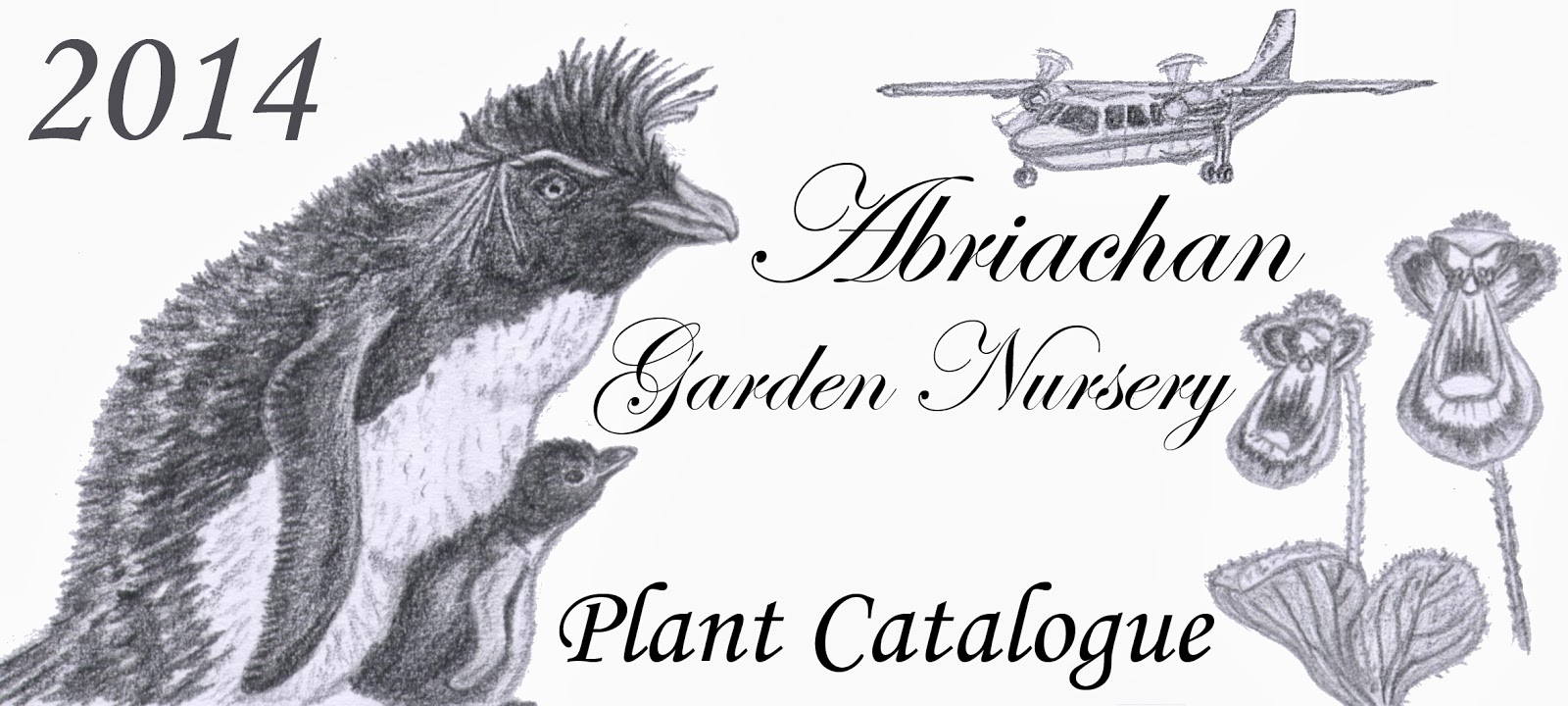
The new 2014 catalogue cover that Cat has done is great, showing three wonderful Falkland icons , Rockhopper Penguins, Islander planes and the Falkland island slipper plant Calceolaria fothergillii.
Our trips to New Zealand continue too, and so our love
affair with the southern hemisphere goes on.
Back here On Loch Ness it has been an extraordinary mild
winter. We have been spared much of the rain and storms that have plagued the
south of England and Wales. It will be very interesting to see how things grow
away, with so little check to their growth.
The February garden at Abriachan is a delight of snowdrops, snowflakes
and the Daphne bholua sends a long trail of intoxicating scent along the
pathways. The evergreens are slick and healthy and the flower buds on the
Rhododendrons and Camellias are fat and full of promise, the soil is heaving
with bulbs emerging as we move the leaf fall aside.
Spring is on the move.Margaret
View our 2014 Plant Catalogue Online
Download the 2014 Plant Catalogue
2013 Plant Catalogue - Now Online
ABRIACHAN 30 YEARS ON
We arrived at Abriachan in 1983 after 12 years living and working in the Falkland Islands. It took us time to settle, but somehow, setting up the nursery and beginning the garden did the job.
We began as all gardens should, by planting vegetables and soft fruit, but the stony soil and the oak and hazel woodlands drew us on up the hill.
So what began with a few alpines, swiftly gained momentum? Don sweated away creating dry stone walls and paths, criss-crossing the hill side and gradually our woodland and dry slope garden took shape.
I believe gardens are always a reflection of their owners and we are no different. We have lived overseas in New Zealand and the Falklands and we grow plants from both places as they mean something to us and also do pretty well in our climate. Living in Scotland we must accept the limitations of the weather, but nevertheless we find ourselves pushing the boundaries of hardiness all of the time.
Every year we do something new in the garden, and there is still so much to learn. Like many gardeners, we have some favourites and start collections, my personal passions are the old fashion primroses and auricula, and there will be more yet.
It has been 30 years of huge interest and fun. All of our family have contributed in so many ways and together with our staff and the many in our community who have encouraged us over the years; and not least you, our customers who have made our imaginings come true. We have made something beautiful between us.
Thank you all.
Margaret Davidson
The 2013 Abriachan Nurseries Plant Catalogue is now online to download as a pdf and to purchase online through paypal
Hardcopies will be sent out in the post in the next weeks, please contact us if you would like to be added to the mailing list
Spring in Scotland
We are home in Abriachan and this morning was a perfect winter day.
The sunlight came across the Loch and lit up all the golden yellow and glistening dark green of evergreens. It rained overnight and drops of water were glistening along branches and giving a zest to the air.
It has been cold this past week and grey, so to see so many shrubs with flower is a real lift for the sprit.
The early Witch Hazel, Hamamelis x intermedia Pallida is wonderful. It is close by the house, looking magnificent against a blue winter sky.
Walking through the garden yesterday, it is always a surprise how good the moss looks on the stone walls. When the leaves are off the trees, the moss seems to take centre arena and is a perfect foil for winter blooms and early bulbs.
I walked up through the steps and into the woodland, elated to see the upright stems and flowers of Mahonia x media Charity. These branches pull the arch of the sky down within reach.
The Sarcococca confusa; sweet box; behind the Font Stone wall brought a gasp of pleasure as I have never seen it looking so well and with lots of the small dizzily, fragrant flowers amongst the leaves.
The final surprise yesterday was Ilex…..a wonderful variegated holly…..dripping with berries and outlined against the sky.
It’s good to be home and how great is it that our garden greets us with such splendour.
The sunlight came across the Loch and lit up all the golden yellow and glistening dark green of evergreens. It rained overnight and drops of water were glistening along branches and giving a zest to the air.
It has been cold this past week and grey, so to see so many shrubs with flower is a real lift for the sprit.
The early Witch Hazel, Hamamelis x intermedia Pallida is wonderful. It is close by the house, looking magnificent against a blue winter sky.
Walking through the garden yesterday, it is always a surprise how good the moss looks on the stone walls. When the leaves are off the trees, the moss seems to take centre arena and is a perfect foil for winter blooms and early bulbs.
I walked up through the steps and into the woodland, elated to see the upright stems and flowers of Mahonia x media Charity. These branches pull the arch of the sky down within reach.
The Sarcococca confusa; sweet box; behind the Font Stone wall brought a gasp of pleasure as I have never seen it looking so well and with lots of the small dizzily, fragrant flowers amongst the leaves.
The final surprise yesterday was Ilex…..a wonderful variegated holly…..dripping with berries and outlined against the sky.
It’s good to be home and how great is it that our garden greets us with such splendour.
Sweet Peas - The Sweet Smell of a Mammoth
The sweet peas are coming to an end.
The stems are getting shorter and there is more than a little late infestation of green fly, but they have been magnificent and as they say “owe us nothing".
I have always loved sweet peas. They have been an annual highlight and the first few blooms are always eagerly awaited and their scent inhaled with a pleasure and nostalgia.
The variety is called Mammoth - not a pretty name. The plants are vigorous, the stems have been long and straight, the flowers have been huge and have kept coming, but the most wonderful thing has been the wonderful, pleasurable fragrance. The scent of these sweet peas meets you at the door and is a rare pleasure as you cut the blooms.
In water the flowers have lasted almost a week, a long spell for sweet peas , and we have had a big enough crop that we have been sending bunches to market. We will certainly be growing them again next year.
Mammoth is, as I said, especially bred for indoor, poly tunnel cropping. Outdoors we are still recommending the old Spencer varieties as they are the hardiest and have the best colour range that we know.
My favourites have to be the lovely white Honeymoon, and the deep crimson Winston Churchill.
In addition to the Spencers we grow Old Spice mixed, smaller flowers, with a heady, almost tropical, spicy scent. We also grow a single old variety called Matucana. This has deep purple and red flushed flowers and the most remarkable scent of all.
Most folks in the north of the United Kingdom plant their Sweet Pea seed early spring. We often get them in late February/ March ..... but you can plant in autumn on the hope of an early start and early flowers. Always keep your seedlings up and away from mice; they seem to smell them a thousand yards away. Early spring means the day ends with a patrol of many mouse traps.
The seedlings are very hardy and do not need cosseting. However this past spring was so cold in April that it certainly put them back and they were looking very pinched for a while, before they grew away strongly.
Sweet peas love a rich soil and if you are organised enough to know where you will be planting them next year, then this an excellent time to dig a trench and fill it with as much homemade compost and animal manure as you can get your hands on. They will love the rich diet and will reward you with months of undiluted pleasure.
The stems are getting shorter and there is more than a little late infestation of green fly, but they have been magnificent and as they say “owe us nothing".
I have always loved sweet peas. They have been an annual highlight and the first few blooms are always eagerly awaited and their scent inhaled with a pleasure and nostalgia.
![]() |
| Mammoth Mixed |
We are the only nursery I know that sells sweet pea plants in individual sweet pea tubes and in individual colours.
Until this year we have always planted the left overs. By that I mean that after we have sold some thousands of sweet peas, the ones left are those that have lost a label, taken a knock or are an unfashionable colour, and so, in they go, supported by a few hazel branches.
This year Donald experimented with a variety bred especially for poly-tunnels and they were planted in an orderly row and wired up. As reported, they have been wonderful. Until this year we have always planted the left overs. By that I mean that after we have sold some thousands of sweet peas, the ones left are those that have lost a label, taken a knock or are an unfashionable colour, and so, in they go, supported by a few hazel branches.
The variety is called Mammoth - not a pretty name. The plants are vigorous, the stems have been long and straight, the flowers have been huge and have kept coming, but the most wonderful thing has been the wonderful, pleasurable fragrance. The scent of these sweet peas meets you at the door and is a rare pleasure as you cut the blooms.
In water the flowers have lasted almost a week, a long spell for sweet peas , and we have had a big enough crop that we have been sending bunches to market. We will certainly be growing them again next year.
![]() |
| Honeymoon |
My favourites have to be the lovely white Honeymoon, and the deep crimson Winston Churchill.
In addition to the Spencers we grow Old Spice mixed, smaller flowers, with a heady, almost tropical, spicy scent. We also grow a single old variety called Matucana. This has deep purple and red flushed flowers and the most remarkable scent of all.
![]() |
| Winston Churchill |
Most folks in the north of the United Kingdom plant their Sweet Pea seed early spring. We often get them in late February/ March ..... but you can plant in autumn on the hope of an early start and early flowers. Always keep your seedlings up and away from mice; they seem to smell them a thousand yards away. Early spring means the day ends with a patrol of many mouse traps.
The seedlings are very hardy and do not need cosseting. However this past spring was so cold in April that it certainly put them back and they were looking very pinched for a while, before they grew away strongly.
![]() |
| Matacuna |
Subscribe to:
Posts (Atom)


.jpg)


.jpg)
+(with+signature).jpg)
.jpg)
+2.jpg)


.jpg)
.jpg)

.jpg)